-
Demographics, Depleted Resources, and Al Qaeda Inflame Tensions in Yemen
›July 21, 2010 // By Schuyler NullA second spectacular Al Qaeda attack on Yemeni government security buildings in less than a month is a worrisome sign that the terrorist group may be trying to take advantage of a country splitting at the seams. U.S. officials are concerned that Yemen, like neighboring Somalia, may become a failed state due to a myriad of challenges, including a separatist movement in the south, tensions over government corruption charges, competition for dwindling natural resources, and one of the fastest growing populations in the world.
Wells Running Dry
Water shortages have become commonplace in Yemen. Last year, the Sunday Times reported that Yemen could become the first modern state to run out of water, “providing a taste of the conflict and mass movement of populations that may spread across the world if population growth outstrips natural resources.”
Earlier this year, government forces came to blows with locals over a disputed water well license in the south. Twenty homes were damaged and two people were killed during the resulting eight day stand-off, according to Reuters.
The heavily populated highlands, home to the capital city of Sanaa, face particularly staggering scarcity. Wells serving the two million people in the capital must now stretch 2,600 – 3,200 feet below the surface to reach an aquifer and many have simply dried up, according to reports.
Yemeni Water and Environment Minister Abdul-Rahman al-Iryani told a Reuters reporter that the country’s burgeoning water crisis is “almost inevitable because of the geography and climate of Yemen, coupled with uncontrolled population growth and very low capacity for managing resources.”
Nineteen of Yemen’s 21 aquifers are being drained faster than they can recover, due to diesel subsidies that encourage excessive pumping, loose government enforcement of existing drilling laws, and growing population demand. Qat farmers in particular represent an excessive portion of water consumption; growing the popular narcotic accounts for 37 percent of agricultural water consumption. Meanwhile, according to a study by the World Food Programme this year, 32.1 percent of the population is food insecure and the country has become reliant on imported wheat.
Yemen’s other wells – the oil variety – have long been the country’s sole source of significant income. According to ASPO, oil has historically represented 70-75 percent of the government’s revenue. But recent exploration efforts have failed to uncover significant additions to Yemen’s reserves, and as a result oil exports have declined 56 percent since 2001. The steep decline has pushed Yemeni authorities to look to other natural resources, such as rare minerals and natural gas, but the infrastructure to support such projects will take significant time and money to develop.
The Fastest Growing Population in the Middle East
Despite the country’s limited resources, Yemen’s population of 22.8 million people is growing faster than any other country in the Middle East. According to projections from the Population Reference Bureau, by 2050, Yemen’s burgeoning population is expected to rival that of Spain.
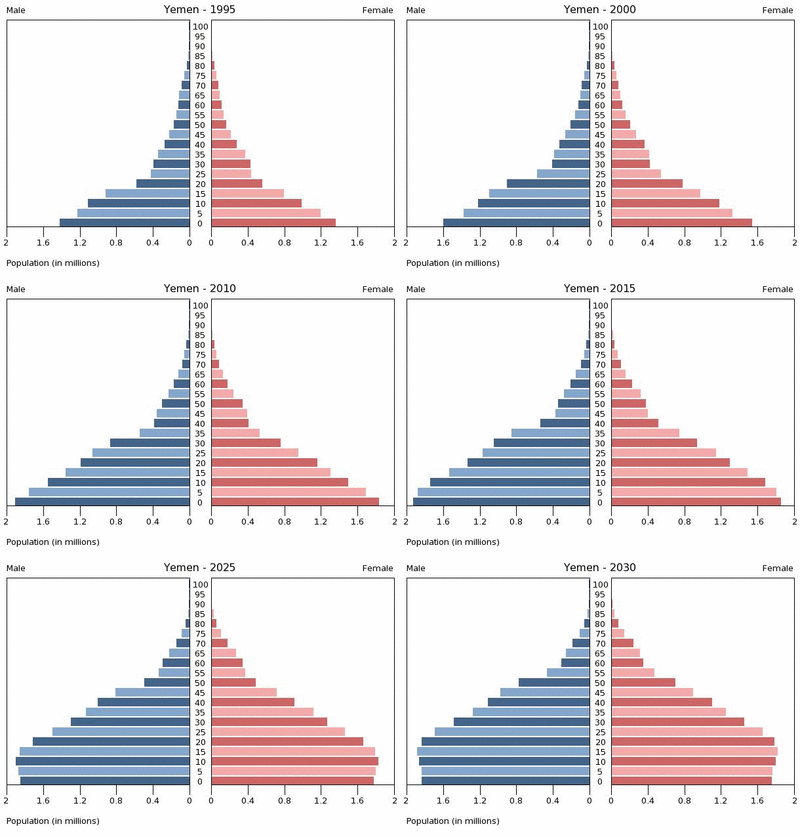
Fully 45 percent of the current population is under the age of 15 – a troubling ratio that is expected to grow in the near future. The charts from the U.S. Census Bureau embedded below illustrate the dramatic growth of the country’s youth bulge from 1995 through 2030.A poor record on women’s rights and a highly rural, traditional society contribute to these rapid growth scenarios. According to Population Action International’s Elizabeth Leahy Madsen, only 41 percent of Yemeni women are literate and their total fertility rate is well over the global average. A recent survey from Social Watch ranking education, economic, and political empowerment rated Yemen last in the world in gender equity. Yemeni scholar Sultana Al-Jeham pointed out during her Wilson Center presentation, “Yemeni Women: Challenges and Little Hope,” that there is only one woman in a national parliament of 301 members and that ambitious political women routinely face systematic marginalization.
A contributing factor is that 70 percent of Yemen’s population live outside of cities – far more than any other country in the region – making access to education and healthcare difficult, especially in the large swaths of land not controlled by the government.
External migration from war-torn east Africa adds to Yemen’s demographic strains. According to IRIN, approximately 700,000 Somali refugees currently reside in country, and that number may grow as the situation in Somalia continues to escalate. Within Yemen’s own borders, another 320,000 internally displaced people have fled conflict-ridden areas, further disrupting the country’s internal dynamics.
Corruption and Rebellion
Competition over resources, perceived corruption, and Al Qaeda activity have put considerable pressure on the Saleh regime in Sanaa. The government faces serious dissidence in both the north and the south, and the Los Angeles Times reports that talk of rebellion is both widespread and loud:Much of southern and eastern Yemen are almost entirely beyond the central government’s control. Many Yemeni soldiers say they won’t wear their uniforms outside the southern port city of Aden for fear of being killed. In recent months, officials have been attacked after trying to raise the Yemeni flag over government offices in the south.
USAID rates Yemen’s effective governance amongst the lowest in the world (below the 25th percentile), reflecting Sanaa’s poor control and high levels of corruption. Some reports claim that up to a third of Yemen’s 100,000-man army is made up of “ghost soldiers” who do not actually exist but whose commanders collect their salaries and equipment to sell on the open market.
The West and Al Qaeda
In testimony before Congress earlier this year, Assistant Secretary of State Jeffrey Feltman called on the Yemeni government to take a comprehensive approach to “address the security, political, and economic challenges that it faces,” including its natural resource and demographic challenges.
The Yemeni government is poised to receive $150 million in bilateral military assistance from the United States. But some experts are critical of that approach: Dr. Mustafa Alani of the Dubai-based Gulf Research Center told UN Dispatch that, “you are not going to solve the terrorist problem in Yemen by killing terrorists,” calling instead for investing in economic development.
USAID has budgeted $67 million for development assistance, economic support, and training programs in Yemen for FY 2010 and has requested $106 million for FY 2011 (although about a third is designated for foreign military financing).
While Yemen’s Al Qaeda presence continues to captivate Western governments, it is the country’s other problems – resource scarcity, corruption, and demographic issues – that make it vulnerable to begin with and arguably represent the greater threat to its long-term stability. The United States and other developed countries should address these cascading problems in constructive ways, before the country devolves into a more dangerous state like Somalia or Afghanistan. In keeping with the tenets of the Obama administration’s National Security Strategy, an exercise in American soft power in Yemen might pay great dividends in hard power gains.
Sources: Association for the Study of Peak Oil – USA, Central Intelligence Agency, Congressional Research Service, Guardian, IRIN, Los Angeles Times, New York Times, Population Action International, Population Reference Bureau, ReliefWeb, Reuters, Social Watch, Sunday Times, U.S. Census Bureau, U.S. Department of State, UN Dispatch, USA Today, USAID, World Food Programme.
Photo Credit: “Yemen pol 2002” via Wikimedia Commons courtesy of the U.S. Federal Government and “Yemen youth bulge animation” arranged by Schuyler Null using images courtesy of the U.S. Census Bureau’s International Data Base. -
In Kampala, African Leaders Discuss Maternal Health While Attacks Renew Concern over Somalia
›July 19, 2010 // By Schuyler NullLeaders from 49 African countries are meeting today in Kampala, Uganda, at the start of a scheduled week-long African Union (AU) summit on maternal and child health. Uganda is a fitting location, as it faces some of the toughest health and demographic challenges in Africa, including a very young and rapidly growing population and poor maternal health services. However, with the memory of last week’s twin bomb blasts still fresh, peace and security issues will surely be on the agenda as well.
Somalia’s lead insurgency group, Al Shabab, took responsibility for the attacks in Kampala, which killed more than 70 people. Al Shabab’s first prominent cross-border attack is only the latest sign that Somalia’s issues – which also include a very young and rapidly growing population – are starting to spill over its borders. For more on Somalia’s deepening crisis and its effects on the East African region, see New Security Beat’s recent analysis: “As Somalia Sinks, Neighbors Face a Fight to Stay Afloat.”
Sources: AP, Washington Post.
Photo Credit: Adapted from “Ugandan African Union contingent in Mogadishu, Nov. 25, 2007” courtesy of flickr user david axe. -
New Security Challenges in Obama’s Grand Strategy
›June 4, 2010 // By Schuyler NullPresident Obama’s National Security Strategy (NSS), released last week, reinforces a commitment to the whole of government approach to defense, and highlights the diffuse challenges facing the United States, including international terrorism, globalization, and economic upheaval.
Following the lead of the Quadrennial Defense Review released earlier this year, the NSS for the first time since the Clinton years prominently features non-traditional security concerns such as climate change, population growth, food security, and resource management:Climate change and pandemic disease threaten the security of regions and the health and safety of the American people. Failing states breed conflict and endanger regional and global security… The convergence of wealth and living standards among developed and emerging economies holds out the promise of more balanced global growth, but dramatic inequality persists within and among nations. Profound cultural and demographic tensions, rising demand for resources, and rapid urbanization could reshape single countries and entire regions.
By acknowledging the myriad causes of instability along with more “hard” security issues such as insurgency and nuclear weapons, Obama’s national security strategy takes into account the “soft” problems facing critical yet troubled states – such as Pakistan, India, Afghanistan, and Somalia – which include demographic imbalances, food insecurity, and environmental degradation.
Not surprisingly, Afghanistan in particular is highlighted as an area where soft power could strengthen American security interests. According to the strategy, agricultural development and a commitment to women’s rights “can make an immediate and enduring impact in the lives of the Afghan people” and will help lead to a “strong, stable, and prosperous Afghanistan.”
The unique demographic landscape of the Middle East, which outside of Africa has the fastest growing populations in the world, is also given intentional consideration. “We have a strategic interest in ensuring that the social and economic needs and political rights of people in this region, who represent one of the world’s youngest populations, are met,” the strategy states.
Some critics of that strategy warn that the term “national security” may grow to encompass so much it becomes meaningless. But others argue the administration’s thinking is simply a more nuanced approach that acknowledges the complexity of today’s security challenges.
In a speech on the strategy, Secretary of State Clinton said that one of the administration’s goals was “to begin to make the case that defense, diplomacy, and development were not separate entities either in substance or process, but that indeed they had to be viewed as part of an integrated whole and that the whole of government then had to be enlisted in their pursuit.”
Compare this approach to President Bush’s 2006 National Security Strategy, which began with the simple statement, “America is at war” and focused very directly on terrorism, democracy building, and unilateralism.
Other comparisons are also instructive. The Bush NSS mentions “food” only once (in connection with the administration’s “Initiative to End Hunger in Africa”) and does not mention population, demography, agriculture, or climate change at all. In contrast, the 2010 NSS mentions food nine times, population and demography eight times, agriculture three times, and climate change 23 times – even more than “intelligence,” which is mentioned only 18 times.
For demographers, development specialists, and environmental conflict specialists, the inclusion of “new security” challenges in the National Security Strategy, which had been largely ignored during the Bush era, is a boon – an encouraging sign that soft power may return to prominence in American foreign policy.
The forthcoming first-ever Quadrennial Diplomacy and Development Review by the State Department will help flesh out the strategic framework laid out by the NSS. It is expected to provide more concrete policy for integrating defense, diplomacy, and development. Current on-the-ground examples like USDA embedding in Afghanistan, stepped-up development aid to Pakistan, and the roll-out of the administration’s food security initiative, “Feed the Future,” are encouraging signs that the NSS may already be more than just rhetoric.
Update: The Bush 91′ and 92’ NSS also included environmental considerations, in part due to the influence of then Director of Central Intelligence, Robert Gates.
Sources: Center for Global Development, CNAS, Los Angeles Times, State Department, USAID, White House, World Politics Review.
Photo Credit: “Human, Food, and Demographic Security” collage by Schuyler Null from “Children stop tending to the crop to watch the patrol” courtesy of flickr user isafmedia, “Combing Wheat” courtesy of flickr user AfghanistanMatters, and “Old Town Sanaa – Yemen 49” courtesy of flickr user Richard Messenger. -
Can Food Security Stop Terrorism?
›May 28, 2010 // By Schuyler NullUSAID’s “Feed the Future” initiative is being touted for its potential to help stabilize failing states and dampen simmering civil conflicts. Speaking at a packed symposium on food security hosted by the Chicago Council last week, USAID Administrator Rajiv Shah called food security “the foundation for peace and opportunity – and therefore a foundation for our own national security.”
-
As Somalia Sinks, Neighbors Face a Fight to Stay Afloat
›May 14, 2010 // By Schuyler NullThe week before the international Istanbul conference on aid to Somalia, the UN’s embattled envoy to the country, Ahmedou Ould-Abdallah, warned the Security Council that if the global community “did not take the right action in Somalia now, the situation will, sooner or later, force us to act and at a much higher price.”
The UN High Commission for Refugees (UNHCR) also issued strong warnings this week. Deputy High Commissioner Alexander Aleinikoff said in Geneva, “The displacement crisis is worsening with the deterioration of the situation inside Somalia and we need to prepare fast for new and possibly large-scale displacement.”
But the danger is not limited to Somalia. The war-torn country’s cascading set of problems – criminal, health, humanitarian, food, and environmental – threaten to spill over into neighboring countries.
A Horrendous Humanitarian Crisis
The UN- and U.S.-backed Transitional Federal Government (TFG) controls only parts of Mogadishu and small portions of central Somalia, while insurgent group Al Shabab controls nearly the entire south. The northern area is divided into semi-autonomous Somaliland and Puntland, which also fall outside of the transitional government’s control.
But the civil war is only one part of what Ould-Abdallah called a “horrendous” humanitarian crisis.
According to the UN, 3.2 million Somalis rely on foreign assistance for food – 43 percent of the population – and 1.4 million have been internally displaced by war. Another UN-backed study finds that approximately 50 percent of women and 60 percent of children under five are anemic. Most distressing, the UN Security Council reported in March that up to half of all food aid sent to Somalia is diverted from people in need by militants and corrupt officials, including UN and government employees.
Because of the country’s large youth bulge – 45 percent of Somalia’s population is under the age of 15 – food and health conditions are expected to get much worse before they get better. In the 2009 Failed States Index, Somalia ranks as the least stable state in the world and, along with Zimbabwe, has the highest demographic pressures.
Islamic Militants and the Battle for the High Seas
Yet the West continues to focus on the sensational pirate attacks on Somalia’s coast. The root cause of these attacks is not simply lawlessness say Somali officials, instead, they began partly as desperate attempts to stop foreign commercial fleets from depleting Somalia’s tuna-rich, lawless shores. A 2006 High Seas Task Force reported that at any given time, “some 700 foreign-owned vessels are engaged in unlicensed and unregulated fishing in Somali waters, exploiting high value species such as tuna, shark, lobster and deep-water shrimp.”
The transitional government opposes the fishermen-turned-pirates, but can do little to stop them. Al Shabab has thus far allowed pirates to operate freely in their territory. Their tacit approval may be tied to reports that the group has received portions of ransoms in the past.
Another hardline Islamist group, Hizbul Islam, recently took over the pirate safe haven of Haradhere, allegedly in response to local pleas for better security, but the move may simply have been part of an ongoing struggle with Al Shabab for control of pirate ransoms and port taxes – one of the few sectors of the economy that has remained lucrative.
“I can say to you, they are not different from pirates — they also want money,” Yusuf Mohamed Siad, defense minister with Somalia’s TFG, told Time Magazine.
A Toxic ThreatInitially the pirates claimed one of their goals was to ward off “mysterious European ships” that were allegedly dumping barrels of toxic waste offshore. UN envoy Ould-Abdallah told Johann Hari of The Independent in 2009 that “somebody is dumping nuclear material here. There is also lead, and heavy metals such as cadmium and mercury – you name it.” After the 2005 tsunami, “hundreds of the dumped and leaking barrels washed up on shore. People began to suffer from radiation sickness, and more than 300 died,” Hari reports.
Finnish Minister of Parliament Pekka Haavisto, speaking to ECSP last year, urged UN investigation of the claims. “If there are rumors, we should go check them out,” said the former head of the UN Environment Program’s Post-Conflict Assessment Unit:I think it is possible to send an international scientific assessment team in to take samples and find out whether there are environmental contamination and health threats. Residents of these communities, including the pirate villages, want to know if they are being poisoned, just like any other community would.
To date, there has been no action to address these claims.
Drought, Deforestation, and Migration
While foreign entities may have been exploiting Somalia’s oceans, the climate has played havoc with the rest of the country. Reuters and IRIN report that the worst drought in a decade has stricken some parts of the interior, while others parts of the country face heavy flooding from rainfall further upstream in Ethiopia.
Land management has also broken down. A 2006 Academy for Peace and Development study estimated that the province of Somaliland alone consumes up 2.5 million trees each year for charcoal, which is used as a cheaper alternative to gas for cooking and heating. A 2004 Somaliland ministry study on charcoal called the issue of deforestation for charcoal production “the most critical issue that might lead to a national environmental disaster.”
West of Mogadishu, Al Shabab has begun playing the role of environmental steward, instituting a strict ban on all tree-cutting – a remarkable decree from a group best known for their brutal application of Sharia law rather than sound governance.
The result of this turmoil is an ever-increasing flow of displaced people – nearly 170,000 alone so far this year, according to the Washington Post – driven by war, poverty, and environmental problems. The burden is beginning to weigh on Somalia’s neighbors, says the UNHCR.
The Neighborhood Effect
One of the largest flows of displaced Somalis is into the Arabian peninsula country of Yemen – itself a failing state, with 3.4 million in need of food aid, 35 percent unemployment, a massive youth bulge, dwindling water and oil resources, and a burgeoning Al Qaeda presence.
In testimony on Yemen earlier this year, Assistant Secretary of State Jeffrey Feltman said that the country’s demographics were simply unsustainable:Water resources are fast being depleted. With over half of its people living in poverty and the population growing at an unsustainable 3.2 percent per year, economic conditions threaten to worsen and further tax the government’s already limited capacity to ensure basic levels of support and opportunity for its citizens.
Other neighboring countries face similar crises of drought, food shortage, and overpopulation – Ethiopia has 12 million short of food, Kenya, 3.5 million, says Reuters. UNHCR reports that in Djibouti, a common first choice for fleeing Somalis, the number of new arrivals has more than doubled since last year, and the country’s main refugee camp is facing a serious water crisis.
A Case Study in Collapse
The ballooning crises of Somalia encompass a worst-case scenario for the intersection of environmental, demographic, and conventional security concerns. Civil war, rapid population growth, drought, and resource depletion have not only contributed to the complete collapse of a sovereign state, but could also lead to similar problems for Somalia’s neighbors – threatening a domino effect of destabilization that no military force alone will be able to prevent.
Speaking at a naval conference in Abu Dhabi this week, Australian Vice Admiral Russell Crane told ASD News that, “The symptoms (piracy) we’re seeing now off Somalia, in the Gulf of Aden, are clearly an outcome of what’s going on on the ground there. As sailors, we’re really just treating the symptoms.”
Sources: Academy for Peace and Development, AP, ASD News, Carnegie Endowment for International Peace, Christian Science Monitor, Foreign Policy, High Seas Task Force, Independent, IRIN, New York Times, Population Action, Population Reference Bureau, Reuters, Telegraph, Time, UN, US State Department, War is Boring, Washington Post.
Photo Credits: “Don’t Swim in Somalia (It’s Toxic)” courtesy of Flickr user craynol and “Somalia map states regions districts” courtesy of Wikimedia Commons.
Showing posts from category Somalia.